Showing posts with label Math. Show all posts

Sunday, October 21, 2012

Shapes, Shapes, & More Shapes

Shapes Unit Following Directions
I have been working on developing a shapes unit that includes many different skill levels. I have submitted a 40 page unit to Teachers Pay Teachers. You can find the unit at the following link:  http://www.teacherspayteachers.com/Product/Shapes-Shapes-More-Shapes

The most challenging level are the first pages that involve reading, following directions, counting, and coloring. For students that do not yet read you can read the directions to them. An example is pictured on the right.  Sample Page

The next set of worksheets involve tracing, coloring, or cutting out shapes. The individual shape worksheets are simple. However the worksheets with multiple shapes are more complex. Sample Page

Finally there are 3 different sets of memory games. The first set all the shapes are the same color and the student matches the shape to the word. Second each shape is a different color so 2 blue circles, 2 red squares... With this type the student may be matching based on color and not shape (so it is a little more simple) Last all the shapes are different colors this way the child has to recognize the shape and not use the color as a prompt.

These worksheets can be completed in a whole group setting, small group, or individual work, centers, or TEACCH.

Shapes Unit - Tracing and Cutting
Shapes Unit Memory Game


Wednesday, October 17, 2012

Froggy Counting

Froggy Counting ~ Flies
I created a froggy counting activity for my students. The packet includes a black line master and color version. The froggy unit is free on Teachers Pay Teachers http://www.teacherspayteachers.com/Product/Froggy-Counting This activity can be used in several ways:
  • Print the black line copy to give to each student. Then using stamp ink they can "squash" the flies as they count the flies. This is great because they will know if they have counted that fly already or not and this skill works on finger isolation (fine motor)
  • Print the color version, cut in half, and laminate. Have the students use small fly swatters or something similar to swat the flies as they count. After they have counted the flies they can place the corresponding fly number on each froggy.
  • This activity can also be placed in a center or independent work station or used in a TEACCH task to promote independent work.


Froggy Counting ~ Flies


Saturday, August 25, 2012

Multiplication

I always try to teach my students how to complete multiplication independently. However sometimes they need some extra help and here are some of the things that can assist them. Teach the students a song to remember how to count by each number.

2 X Tables = Yankee Doodle Dandy
3 X Tables = Row Row Row Your Boat
4 X Tables = Twinkle Twinkle Little Star
5 X Tables = Teach a Regular/Steady Beat
6 X Tables = London Bridge or Mary Had a Little Lamb
7 X Tables =Mary Had a Little Lamb or Are You Sleeping
8 X Tables = This Old Man
9 X Tables = Yankee Doodle Dandy or Rudolf the Red Nose Reindeer

Also teach your students how to use a multiplication table. This can be a great visual support when they are learning their times tables.
Multiplication Table Printable

Multiplication Table

Dollar More


Dollar More - With Visual Supports
I love teaching the dollar more strategy. For kids that have greater difficulty adding coins and bills together this strategy is genius. What you do is provide the students with a price for example $2.80. The student gives $2.00 for the bills and a "Dollar More" for the change to equal $3.00. What I created was a visual support to help students understand the difference between money before the decimal and the change after the decimal. This visual support has been extremely effective in teaching money skills. I like to place several pictures with the prices in front of the student and have them select the one they want to work on. This way we can also work on the skill of knowing if you have enough money to buy particular items. Here are a few suggestions to help with generalization and motivation.

1. Always use real money. If you are worried about stealing, keep the money in a locked box but use real money.

2. Find things the students would be interested in buying to have them practice their money skills. Then use a picture or the actual item while they practice. 

3. While teaching this skills also work on having the student identify if they have enough money to purchase an item. I like to place their favorite picture/item in front of them and then give them slightly less money than they need. This way they understand that just because you have money doesn't mean you can buy anything you want.

***4. If you have a student who is reluctant to work this can also be used as a behavior motivator. I will start the student off with $1.00. Then ask them which item they would like to buy and these are things that are classroom reinforcers such as run time, sensory time, extra recess, book time, special toy, small snack, anything reinforcing. Then I tell them that it will cost $6.00 to earn that particular item. The way they earn their money is to complete tasks in the classroom. One line of math = $1.00. One fine motor task = $1.00. Reading a story = $2.00, etc. This is like the "I am working for" program but requires a high level of thinking and a real life connection to money and the value of money. As the students become better at working I increase the amount of money to earn a given reinforcer.

5. You can also provide the students with a set of prices and bills to complete this task in your TEACCH system - You would want to closely monitor the money. One way to do this would be to have price cards in the TEACCH box and then the students would request the money from the teacher and return the money afterwards.

6. After the students are comfortable with using dollar bills then increase the difficulty level by having five dollar bills, then ten, and twenty dollar bills.
Dollar More - With Real Money  Visual Support
 Dollar More Printable

Thursday, August 9, 2012

Movement with Dice

I found these wonderful soft cube dice that allow you to change the picture, word, number, etc that is on each side. Oh the possibilities! The first day I tried them I placed colored paper all around the room. The kids rolled a color die and a movement die and then went found the correct color by moving around the room. They thought this was the greatest activity ever. They worked on their gross motor skills and color skills. Next I am going to try numbers and movement. What is great about these dice are the fact that I can change what skill they are working on from things like the movement to retelling parts of a story to multiplication facts. Like I said the possibilities are great!
Movement printable


Soft Dice with Plastic Picture Inserts

Wednesday, July 11, 2012

Shape Printables - Star


Shape Printable - Stars

I wanted to incorporate more skills into simple activities. This is a worksheet about the star shape. This worksheet is extremely simple to adjust to different skill levels. Your students who can read have them read and follow the directions. The kiddos that are learning to read monitor and help out as necessary. For non-readers read the directions to them. For kids that are working on matching colors you can outline the star with the color and have them finish coloring with the same color. The final 2 questions on the worksheet involve counting. I wanted to address multiple areas. Below you will find the star printable.
 
Star File 

For my full shape printable check out: http://www.teacherspayteachers.com/Product/Shapes-Shapes-More-Shapes


Wednesday, June 27, 2012

Painting with Q-tips

Painting with Q-tips


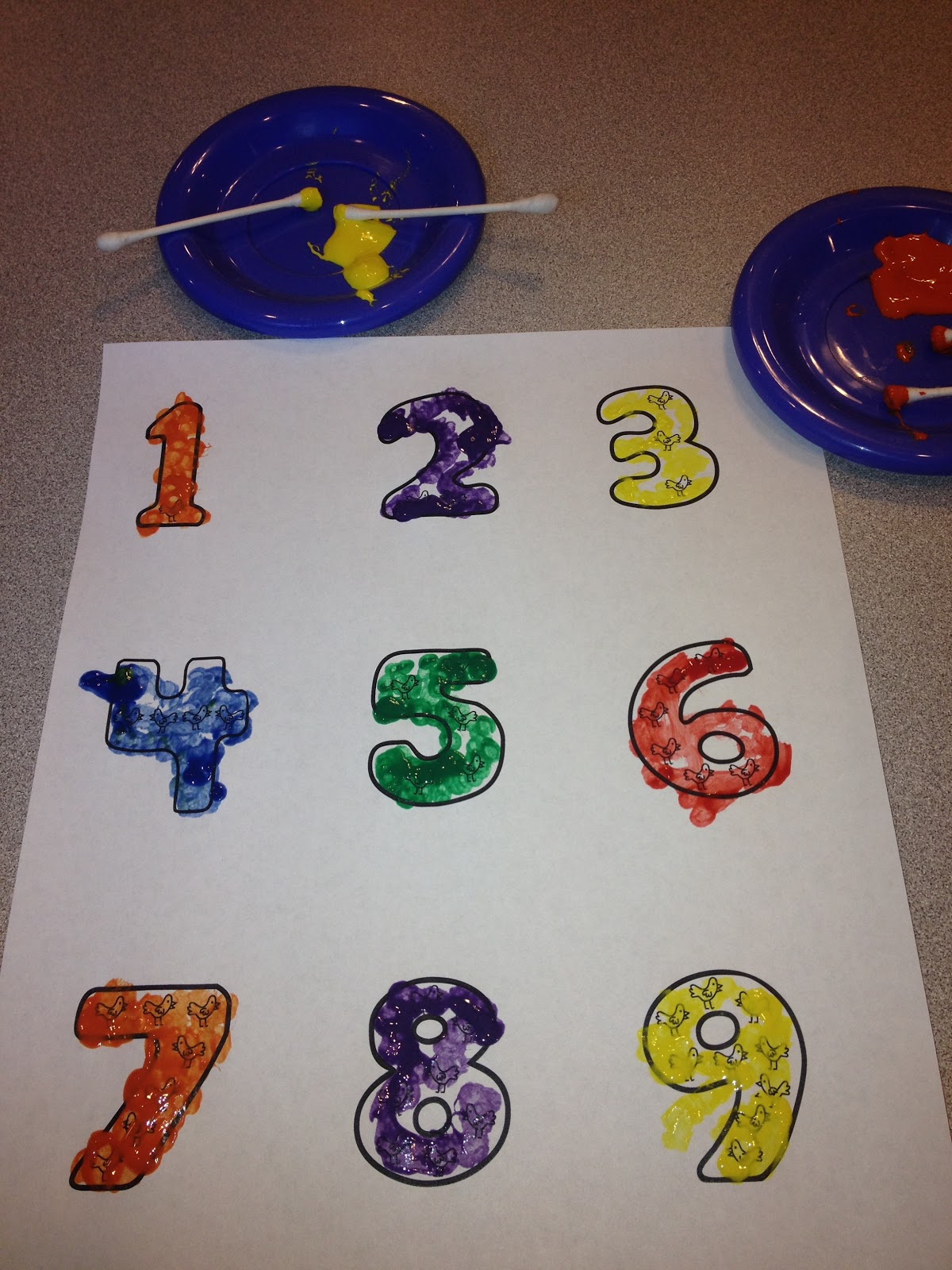
The letter of the week in preschool is Qq and I wasn't sure what activities to do... Then I had an idea that would not only work on the letter of the week but would also address fine motor skills and artistic fun - painting with Q-tips. I placed a glob of paint on small plastic plates with 2 Q-tips. There were 9 colors to choose from. The kids chose a color and began painting. For the number and letter page I had them create dots using the Q-tips. We called this dot art. I was amazed to see that they were able to stay more closely on the line or in the lines using Q-tips than with crayons. Their motor control was more precise using the Q-tips. Then on the gumball machine with counting I had them paint back and forth with Q-tips. The kids enjoyed both painting techniques.
Painting with Q-tips

Tuesday, June 19, 2012

Ice Cream Cone Count & Read

Ice Cream Cone Counting
This is a simple TEACCH task I enjoy using. The kids read the sentence which will be repetitive on each card. You can work on specific sight words, found in their reading. I wanted my students to learn "I" "see" "the" and the color words. The kids figured out the word for ice cream because of the picture cues. Print on card stock - each card is only a 1/2 page, laminate, and place a dry erase marker in the TEACCH task. Have the students write their answer in the box with the marker. In the printable you will find simple counting from 0-20 and counting by colors. This is a simple task to change up depending on the seasons or holidays. With each month it is also good to change up the reading just a bit to work on new sight words.   

Ice Cream Cone Printable

Wednesday, June 6, 2012

M & M Math & Motor

M & M Graphing - Sorting
M & M's are a wonderful candy that the kids enjoy and so many activities can be done with these small candies. Here are a few ideas to do with m & m's count and graph the m&m's by color. You can download the file below. Here are a few ways to make this activity a bit more challenging: 1. Use tweezers to pick up and move each m&m 2. push the m&m's onto the grid using chop sticks. 3. Have the kids predict how many of each color they will have in their bag and then compare to the actual amount. 4. Use 2 dice one with colors and one with numbers. Have the students roll both dice and then that is the color and number of m&m's they add to their graphs.

Another fun idea with m&m's is to sort them by size. You can find mini m&m's, regular m&m's and peanut or peanut butter m&m's for 3 different sizes. Then have the kids sort them into groups by size.

M&M Graph

Saturday, April 21, 2012

Bug Counting Book

Spring has sprung and the insects are coming out to play. This is a counting book for numbers 1-10 with a variety of bugs. (printable is listed below) The kids are having fun coloring the bugs and practicing their numbers. A fun activity to do, to help your little kiddos get some of the sillies out is to have them transition like a bug. When they move from group to group have them do things like:

Bug Counting Book 1-10
Jump like a grasshopper
Fly like a butterfly
Wiggle like a caterpillar
March like an ant
Buzz like a bee
Spin like a spider
Roll like a roly poly bug

Bug Counting

Saturday, March 24, 2012

Letter G - Gumballs


Gumball Machines - Numbers

Gumball Machine - Colors with pom poms
My preschool kiddos are working on the letter G g this week. I created this activity using a gumball machine. The activity allows the kids to sort the gumballs by color or number. You can use the printable gumballs that are included in the download, the kids can draw their own circles and color them to work on fine motor skills. The gumball machines are in all sorts of colors I found all sorts of pom poms in a wide variety of colors and sizes, the kids picked up the pom poms using tweezers to help those fine motor skills. Their number worksheet they placed small stickers on each gumball machine. This could be used as an independent task (TEACCH) or a whole group task.  Gumball Printable


Gumball Machine - Printable

Tuesday, March 20, 2012

Egg Counting

Egg Counting
There are so many things to do with Easter Eggs and the Egg shape. Here is one idea. I made a simple oval (egg) on card stock, cut out and laminated. Then I hid the eggs all around the room. The kids had to find the numbers and dots and match them together. They thought this was lots of fun because they were up and moving around however they were learning too. Whenever my students are matching I always make sure that I am assessing what I intended. Many matching games make the 2 items that go together the same color, shape, design, etc. If this occurs then the child may only be matching by a visual discrimination of one of those features and not what you intended for them to learn.  You could also put this type of task in a TEACCH system. I would have the students paperclip the matching items together by doing this you have also added a fine motor component. Download the printable numbers 1-12 here. Egg Counting Printable

Wednesday, February 22, 2012

Color Words

Many kids need lots of practice with colors. This is a task that is in my TEACCH system (independent work). The child matches the colored balloon to the word, and places the word in the library pocket. The version here requires the child to read. To make the task more simple, you could have them match a 3x5 card that is the same color or different hues of the same color (light red, dark red, bright red) to the library pocket. To go even easier have the child match exactly the same picture to the library pocket.
Color - Matching

Sunday, February 12, 2012

Lucky Charms Graphing

Lucky Charms Graphing
St. Patrick's Day is a fun time to work on math skills with Lucky Charms. I hand out a small baggy with Lucky Charms. The kids separate the shapes into groups and then graph how many they have. When they are finished we complete a graph as a class to see which shape has the most and least. Lucky Charms Download.

Friday, February 10, 2012

Money Library Pockets

Money Library Pockets - TEACCH

Money Library Pocket with Touch Dots on Money
Money is such a challenging skill for kids to learn and then to generalize to real life situations. This is an activity that I made to incorporate money skills into independent work in my TEACCH system. I found these money stickers at a teacher supply store. I put various amounts on each library pocket. One version has touchdots and one without. Then I made corresponding cards with pictures and prices. This is to help the kids learn to read price tags.  

Ideas for generalization of money: Vending Machines. Field Trips to a dollar store, if you cannot go to a store bring the store to the classroom and use real money to purchase items. Class stores with class money to learn about saving, spending, reading prices, and understanding if you have enough to buy a particular item.

Tuesday, February 7, 2012

Math Mats

Several years ago I was at a conference and a colleague of mine and we created several TEACCH tasks using our laptops. This is a math task Rebecca created. This is one of the tasks we made. The format comes from a program called Boardmaker. The fonts include "Fonts 4 Teachers" We also used Touch Dots on our numbers. What you do is print out the orange number boards on card stock and laminate. Then print out the numbers you want to use, cut and laminate. You can work on number recognition, object counting, addition, subtraction, reading the number words, etc. (this will make more sense if you look at the document that I have linked below) Then place the task in your TEACCH system. You could place 2 or 3 numbers at one time or 0-10 depending on the students academic level.  Math Mats Link

Fishy Numbers


Students love when work is not a simple worksheet. I have tried to come up with fun ideas to engage my students. This is part of an ocean unit that I teach my students. You can either ask the kids how many fish are in the bowl. You can work on simple addition and subtraction. I have each student put together their own fishbowl. I have used goldfish crackers where each student places the correct number of crackers on each fish.

This link will take you to the printout for the activity - Touch Dots Fish

Monday, January 30, 2012

Christmas Time Math

Math with Library Pockets
I try to make work a little more fun by adding themes to many of the activities. This just changes things up a bit. For this task I laminated library pockets and 3x5 flashcards with math problems. Again you can always make this task easier or more challenging. An easier version would be object counting on the flashcards versus a math problem with numbers. You could add touch dots to the numbers. On the pockets you could simply print the number word which would require reading. I made several sets of these pockets for simple addition, subtraction, multiplication, and division. Library pockets are my fine motor friend.

Friday, January 20, 2012

Pattern Blocks

http://www.learningresources.com

Pattern blocks are useful for teaching patterns, shapes, and colors. I purchased my blocks from Learning Resources because their blocks come in bulk and you can purchase wood or plastic. Then I created my own patterns for the students to follow. Below are pictures that I took using the blocks. These can either be printed out at actual size so that the student can place the blocks directly on the picture for one to one correspondence or printed smaller so that the student looks at the picture and creates a copy. My pictures are laminated to ensure longer use. This is also something that can be done with a group or independently like in a TEACCH system.    

Thursday, January 19, 2012

Unifix Cube Patterns

Unifix Cubes
Here is another idea with Unifix cubes. I have my students recreate the patterns above and then I give them a place to create their own patterns. The graphics are the actual size of the Unifix Cubes, so that children can match the cubes directly for one to one correspondence. This paper was then printed and laminated and placed in my TEACCH system. Unifix cubes have so many uses and really help to improve those fine motor skills.

Patterns for Unifix Cubes